
Is This All For Me?
A bookshop, a pamphlet, a statue

A NOTE: This newsletter is available for free or for $5 a month. If you can subscribe, it goes a long way for me as an independent writer + artist. Thank you for reading!
“Is this all for me?” a young lesbian asked in awe while visiting the Oscar Wilde Memorial Bookshop in the ‘90s.
In the 20th century, finding a gay book—or having one safely mailed to you—was far from simple. Bookshop staff remember people traveling from the Midwest and the South to New York City, stumbling upon the store, and seeing themselves represented in literature for the first time.
As the girl walked through the front doors with her mother, her jaw dropped. “Get anything you’d like,” the mother replied. Her daughter’s arms were filled with books by the end of browsing, grasping fondly onto her first in print stories featuring characters with lives akin to her own.
The first of its kind in the United States, the Oscar Wilde Memorial Bookshop opened its doors during the weekend of November 18-19, 1967. Craig Rodwell, the owner, was 27 years old and had lived in New York City for nine years at that point. His earliest activism started in his teens, though.
Homosexuals of the World Unite
Seventeen-year-old Craig Rodwell, a gay boy in Evanston, Illinois in 1958, printed a couple hundred copies of a leaflet that exclaimed, “Homosexuals of the world unite: Tear off your masks!” He distributed the copies in neighbors’ mailboxes, marking his first act of public education and spurring a lifetime of efforts to destigmatize sexuality, challenge heterosexism, and invite fellow gay people to exist in the world as their authentic selves. About ten years later, Rodwell alongside other youth activists would hand out leaflets during the six-day Stonewall Uprising encouraging people to boycott mafia-owned bars and deny participation in their own oppression. The Stonewall Inn was protested well before the riots started, and the youth gathering at the Bookshop were at the helm.
His groundbreaking work extended to organizing one of the earliest documented gay rights demonstration in the country at Julius’ Bar in Greenwich Village, co-planning the Annual Reminders, and orchestrating significant public events and protests, including Christopher Street Liberation Day beginning in 1970, what we now celebrate as Pride every June.
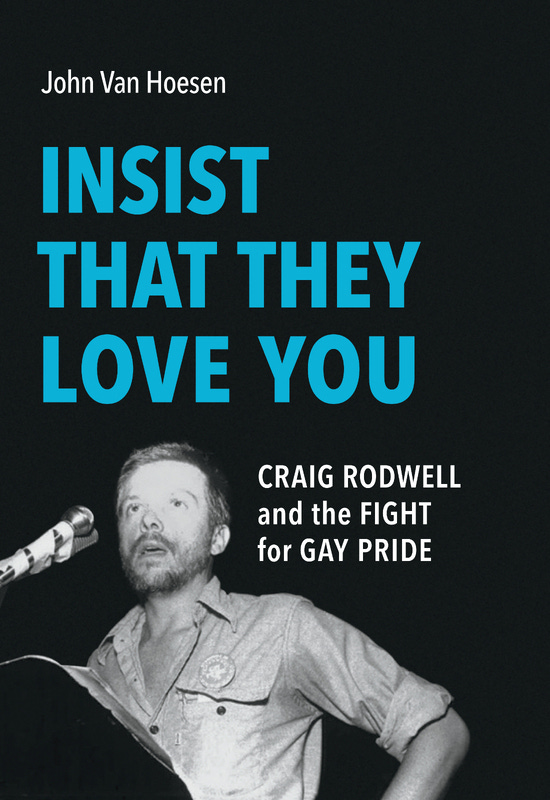
A biography of his life, Insist That They Love You: Craig Rodwell and the Fight for Gay Pride by John Van Hoesen, was published in 2025.
Where could gay people organize for their liberation? During the twentieth century, the answer was a bar, or a restaurant, or a friend’s kitchen table. Rodwell—frustrated with the lack of access to safe spaces, the explicit and subvert messages to hide or feel ashamed, and the manipulation of gay communities by police and landlords—wanted to create something that would not only offer access to gay stories, but would serve as a gathering space for young people and local organizers.
In his press release announcing the opening of the store, he highlights a Community Bulletin Board, “carrying announcements of interest to the student of the homophile movement and the homosexual community.” The store would also serve as a clearing house, he said, “for individuals and organizations supporting homosexual law reform in New York State.” Long before fellowships and programs emerged supporting LGBTQ+ writers, Rodwell said his store would, “act as a spur to homosexual writers who for years have had to write for publishers solely concerned with the heterosexual public”—and it did.
The Print Movement
The growing desire for gay literature was met with the formation of grassroots publications organized by the earliest gay and lesbian groups—the Mattachine Society (1950), ONE Inc. (1952), and the Daughters of Bilitis (1955). Their publications, discreetly mailed to those interested and even investigated by the FBI (deeming their writers '“sex deviates”), became the connection point, the first opportunity to read the works of gay and lesbian writers, poets, journalists, activists.
The women’s bookstore movement came to life only a few years after Rodwell’s shop opened. Amazon Bookstore Cooperative, created by Julie Morse and Rosina Richter in Minneapolis in 1970; New Words Bookstore, founded in 1974 in Cambridge, MA, by Rita Arditti, Gilda Bruckman, Mary Lowry, and Jean MacRae which went on to become the largest feminist bookstore in the country by 1989; and Charis Books & More in Atlanta, founded in 1974 by Linda Bryant and Barbara Borgman and now one of the longest-running feminist bookstores in the United States, together with other bookstores, created what became known as the women-in-print movement. Recent books, including The Feminist Bookstore Movement: Lesbian Antiracism and Feminist Accountability by Kristen Hogan (2016) and A Place Of Our Own by June Thomas (2024) have documented the feminist bookstore movement, especially its lesbian leadership.
Of course, it wasn’t only about readers finding books in their neighborhood or ordering titles by mail. The writers needed opportunities to share their words—to reach readers at all.
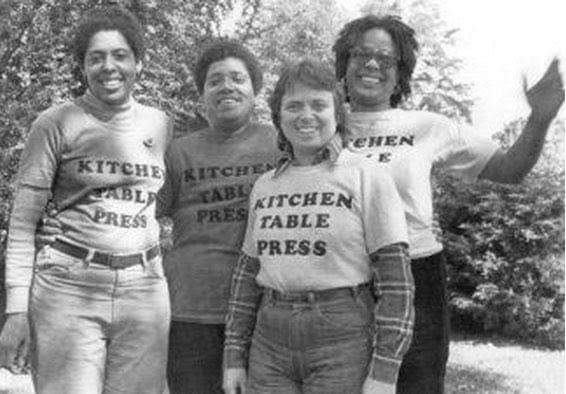
Kitchen Table: Women of Color Press was founded in 1980 after a phone conversations between Barbara Smith and Audre Lorde, becoming one of the first publishers solely focused on women writers of color. Soon after, Firebrand Books opened in 1984 publishing queer works by Dorothy Allison, Alison Bechdel, Cheryl Clarke, Leslie Feinberg, and Jewelle Gomez.
These efforts of the 1970s, 1980s, and beyond influenced broader, longer-term changes in the publishing industry. Over the ensuing decades, publishers like Lee & Low Books have collected data to showcase gaps in the publishing industry (Diversity Baseline Survey), campaigns like #OwnVoices bring attention to authentic representation, and movements such as We Need Diverse Books and Banned Books Week amplify marginalized voices and resist censorship.
Rodwell’s vision for accessible queer literature and physical organizing spaces remains just as urgent in today’s climate of book bans and anti-LGBTQ+ legislation.
HYMN
Cecelia Martin, who worked at the bookshop after Rodwell’s passing, learned of and honored his legacy as the bookshop stayed open until 2009. “When Craig first opened it on Mercer Street,” she says, “It was the LGBT Center. The storefront on Mercer was very public. It was obvious that it was a gay bookstore.” It was intentionally visible to the public, and vocal on issues impacting the neighborhood.
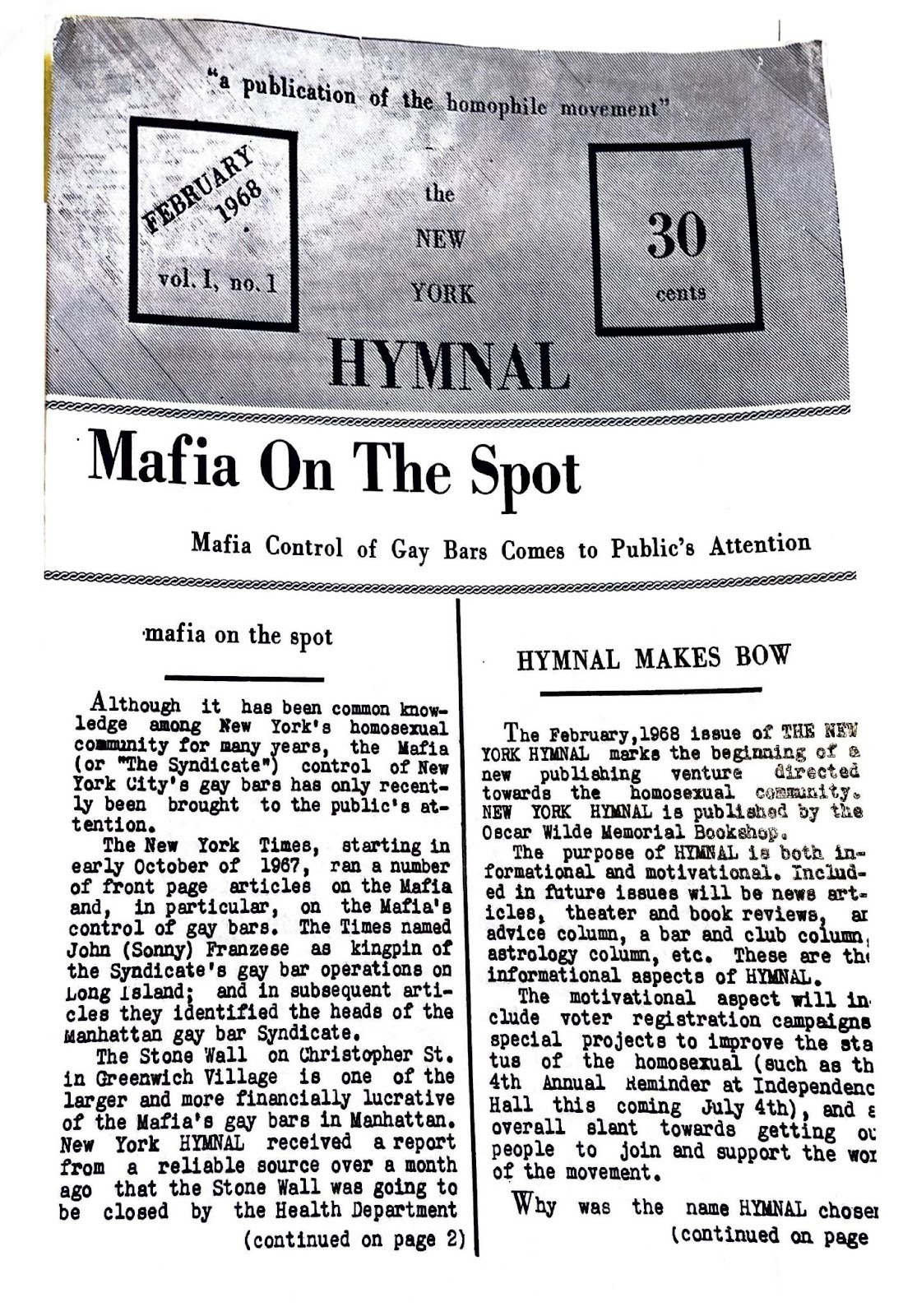
Returning to Rodwell’s goal of acting as a “spur for homosexual writers”—the bookshop began publishing the New York HYMNAL in February of 1968. “The purpose of HYMNAL is both informational and motivational,” the first issue explains. From voter registration, to securing bus tickets for the Annual Reminders, and exposés on mafia-controlled gay bars, the publication aimed to inform and inspire the local homophile movement in NYC and beyond. Within its first year, there were subscribers in 35 states.
The HYMNAL, driven by young people, anticipated the spirit of the Stonewall Uprising a year later. They wrote articles in the preceding year calling out the harm of the Stonewall Inn on the local gay community—exposing the corruption of Stonewall’s owners, investors, and the police. The Homophile Youth Movement of NY (HYMN), the organizing group behind the publication, distributed their work through pamphlets at gay bars and gathering spaces across the Village.
The writers of the HYMNAL approached their work from a liberatory, self-empowering perspective, rejecting strategies that prioritized heterosexual approval or victimhood narratives:
“We will make no pretense of speaking to the heterosexual in trying to persuade him to “accept” homosexuals. HYMNAL is solely concerned with what the gay person thinks of himself. The community has the economic, political, and social potential to shape its own future. This potential only needs to be encouraged and channeled.”
In its early issues, the HYMNAL drew on case studies from the West Coast to shape its policy and organizing recommendations:
“On the West Coast, Gay Power has been used in various ways—supporting candidates for political office, economic boycotts of firms that discriminate against the homosexual, and the publicizing of abuses committed against the Community by organized crime, the police (on occasion), and other governmental and private institutions.”
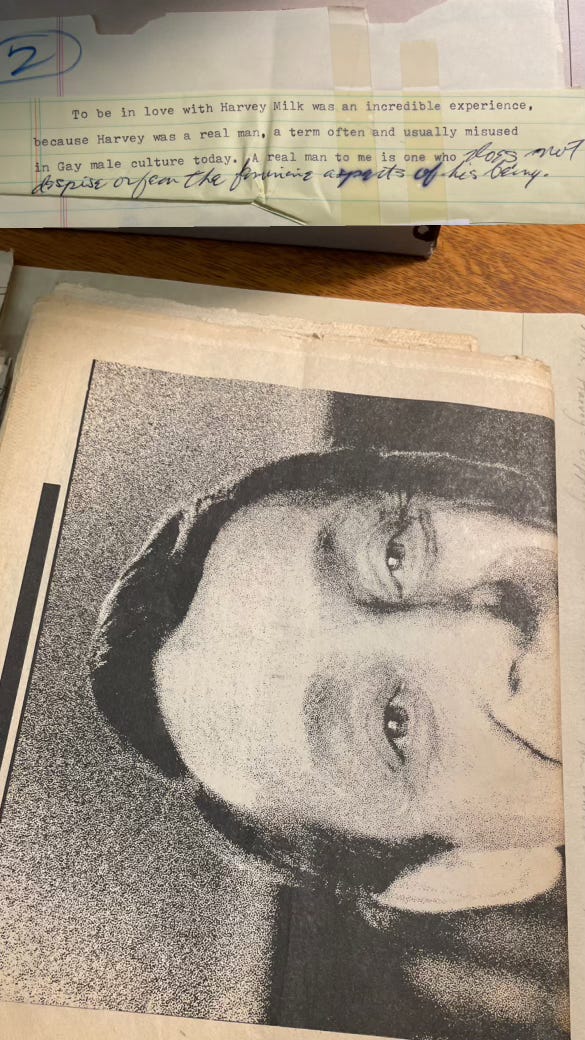
The HYMNAL cited figures like José Sarria, the first openly gay candidate for public office in the US, who ran in San Francisco in 1961; the Tavern Guild of San Francisco, a network of gay bars and the first gay business association in the country, working to protect its patrons from police and mafia harassment; and Harvey Milk, successfully elected to the Board of Supervisors in 1977, becoming the first openly gay elected official in California. Milk was one of Rodwell’s early lovers.
Through these examples, the HYMNAL argued that New York City could follow San Francisco’s lead. Gay-led decision-making was not only possible but essential. They didn’t have to sell themselves to heterosexuals in order to get what they needed to thrive.
Again and again, the paper and the bookstore spoke on national and local decisions affecting gay people, with an emphasis on changes needed in the Village. A letter mailed out to friends on October 11, 1980 begins with:
“It is very difficult for white Gay people to talk about racism—our own racism or even our indifference to it. It has even been suggested by some that a concern about racism was a thing of the 60s and 70s and that the Gay movement of the 80s will center around businesspeople and establishment-type politics-as-usual… we must be more aware of what racism is and how it operates—in much the same manner as heterosexism—and place the Gay movement where it rightfully belongs—at the forefront of the struggle for a just society.”
The letter urged people to show up to a Community Planning Board meeting that Thursday which would determine the future of George Segal’s “Gay Liberation” statue. As a commemoration to Stonewall, the City proposed a statue in Sheridan Square, now Christopher Park and the site of the Stonewall National Monument, depicting four people—presumably two men and two women showing physical affection to one another—all of them painted in white. It was unveiled in 1992.

Rodwell wrote:
“It perpetuates the false idea that the Gay community and the Gay movement are for white people. The four people depicted in the statue are all white; the models are all white; and, contrary to statements from the sponsors, any viewer of this statue will clearly see four white people. If this statue was being proposed ten years ago, it would have consisted of four white men. Some of us have been actively opposing this statue; now we need your help.”
He went on to highlight a prevailing tension around the misuse of funds by cities, non-profits, and individuals in relation to the gay rights movement, sentiments expressed by many queer activists past and present. These particular quotes, though, brought me to Sylvia Rivera’s voice in her “Y’all Better Quiet Down” speech, words fueled by her lived experience.
At twenty-two years old, Sylvia took to the stage, one she hadn’t been invited to (despite her incredibly influential role in caring for NYC youth), at New York City’s Christopher Street Liberation Day Rally in 1973. In her teen years, before meeting Marsha P. Johnson and founding STAR House, Rivera was involved in the Civil Rights Movement, the Women’s Rights Movement, and the anti-war movement. She was also involved with the youth movements, the Young Lords and the Black Panther Party.
Despite her extensive organizing work and advocacy, the gay liberation and women’s liberation movement did not often give Sylvia her flowers. Anti-trans positions at the time dehumanized Rivera, among many others. At her 1973 speech, she urged the gay liberation movement to show up for those who are trans, incarcerated, immigrants, poor, survivors of sexual violence, and unhoused. You can read the transcript of her speech, among others, in this publication by Untorelli Press.
“Revolution now! Gimme a ‘G’! Gimme an ‘A’! Gimme a ‘Y’! Gimme a ‘P’! Gimme an ‘O’! Gimme a ‘W’! Gimme an ‘E’! Gimme an ‘R’! huh— Gay power. Louder! Gay Power!”
–Sylvia Rivera, Y’all Better Quiet Down Speech, 1973
Rodwell wrote to his peers seven years later on the Christopher Street Park monument:
“There are a number of other valid objections that Gay people have to the Segal statue being placed in Christopher Street Park—such as the lack of substantive prior input by either the Gay community or the community at large, esthetic objections, the idea of spending $100,000 for a statue when the most vital needs of the Gay community go unmet, etc. However, the issue of racism and our seeming indifference to it should be paramount. We all claim to be opposed to racism and now is the time to put our rhetorical profession into practice.”
Youth-Led
The Homophile Youth Movement of New York City (HYMN) challenged systemic oppression by mobilizing LGBTQ+ youth to take bold, public action. Before and during the Stonewall Inn Riots of 1969, they handed out pamphlets along Christopher Street, urging fellow gay people to take a stand against the abuses of establishments. At the time of the riots, two trans women who are now known as visionaries in the gay liberation movement—Marsha P. Johnson and Sylvia Rivera—were 23 and 17 years old. This historical fact is often left out of the central narrative about stories of Stonewall: that youth, and the youth organizations that followed, were foundational to modern LGBTQ+ rights.
In 1972 in the Bronx, eighteen-year-old Elie Lamadrid proposed what would become the first Gay-Straight Alliance (GSA) at a high school in the country. The group’s goal was simple yet revolutionary: to create a space where queer students could feel safe and seen in their school. Within months, the group’s efforts extended to demanding rights from their administration, like a sexuality curriculum and removal of any homophobic materials from their school. Elie’s work spurred a movement that would grow exponentially over the coming decades, ensuring legal protections for school GSAs, and inspiring countless young people to advocate for their education.
From classrooms to city halls to community centers and bookstores, LGBTQ+ youth have continually reshaped movements for liberation, proving that the youngest voices can leave a legacy of change.
Generation Queer emerged from this observation—that queer and trans history needed to be told, documented, and celebrated from the lens of youth organizers.
This work comes from research at the LGBT Community Center National History Archive, the New York Public Library, the Schlesinger Library, and Queer History Boston. For corrections to historical facts or to share a related story, please email me at kimmtopping@gmail.com.
UPCOMING OPPORTUNITIES
How To Do Queer History, a course I developed on queer public history, is available fully online! You can sign up here.
I have openings for three new writing clients this spring. You can find the options here—or send me an email about your interests so we can find the best plan for you.
Floriography is open for submissions. Share your poetry, essays, fiction, visual art—we want to share your work!
Generation Queer is almost 9 months old!! Join me for events in Boston next week, or order a signed copy here.
I’m open for workshops, talks, historic tours, and other events in May or June. Reach out for booking details.
Thank you for following along here. <3